Simple Body Oil Recipe: A Water-Free 100-Gram Batch
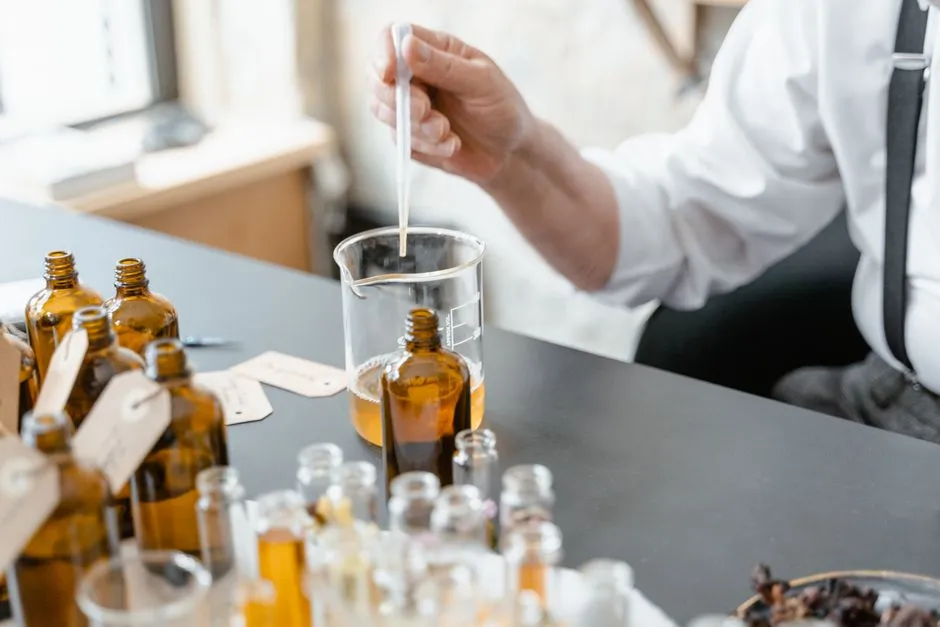
- Three oils, 100 grams, and no mystery water
- Formula for one 100-gram batch
- Choose body-oil ingredients by function
- Equipment
- Clean is necessary; sterile is not a kitchen claim
- Weigh directly and record the actual batch
- Fill a dry pump or reducer bottle
- Test a limited area before broad use
- Apply less than your enthusiasm suggests
- Why the formula has no essential oils
- Why vitamin E is absent
- Never turn it into lotion by adding water
- Storage has an honest boundary, not a magic month count
- Sources
Three oils, 100 grams, and no mystery water
For a simple 100-gram body oil, combine 45 grams high-oleic sunflower oil, 30 grams jojoba, and 25 grams squalane. Transfer the blend to a clean, completely dry, compatible pump bottle and label it with the formula, batch date, ingredient lots, and earliest supplier date.
The arithmetic is pleasantly unenchanted: 45 + 30 + 25 = 100 grams, so the percentages are 45%, 30%, and 25%. There is no water, aloe, hydrosol, tea, fresh herb, essential oil, fragrance, or vitamin E.
Apply a small amount to intact, slightly damp body skin. This is a cosmetic moisturising oil, not a treatment for eczema, acne, psoriasis, scars, infection, pain, inflammation, or any medical condition.
Formula for one 100-gram batch
| Ingredient | Weight | Formula percentage | Job in the blend |
|---|---|---|---|
| High-oleic sunflower oil | 45 g | 45% | Accessible light-to-medium base |
| Jojoba | 30 g | 30% | Silky wax-ester slip |
| Squalane | 25 g | 25% | Lighter, quicker-spreading finish |
| Total | 100 g | 100% | Water-free body oil |
Use cosmetic-grade or appropriately documented personal-care ingredients from traceable suppliers. Verify exact identity, lot, processing, storage, and dates. The carrier-oil buying guide explains why “cold-pressed miracle glow” is not a certificate of analysis.
People with known allergies or sensitive skin should review each source and cross-contact statement with an allergist or dermatologist. Natural origin does not make an ingredient nonallergenic.
Choose body-oil ingredients by function
A useful body-oil ingredient list separates what each material does instead of collecting fashionable names. This formula has three liquid emollients and deliberately leaves four optional categories out.
| Ingredient role | Choice in this formula | Decision rule |
|---|---|---|
| Main liquid base | 45 g high-oleic sunflower oil | Makes up the largest share and gives the blend its light-to-medium body |
| Slip modifier | 30 g jojoba | Adds wax-ester slip without turning the formula into a water-based emulsion |
| Finish modifier | 25 g squalane | Makes the blend spread more quickly and feel lighter |
| Antioxidant | None | Optional in a later documented formula, but not a preservative or shelf-life guarantee |
| Fragrance or essential oil | None | Fragrance-free is complete; adding scent creates new exposure and calculation questions |
| Water, aloe, hydrosol, tea, or wet botanical | None | Adding water changes the formulation and preservation problem entirely |
For any substitution, keep the batch total at 100 grams, change one ingredient at a time, and record the actual weights. The percentage calculation is ingredient grams ÷ total batch grams × 100. In a 100-gram batch, 20 grams is 20%; in a different batch size, grams and percentages are no longer interchangeable.
Before buying, verify the ingredient's exact INCI identity, source and processing description, lot number, supplier date and storage directions, intended cosmetic use, and any allergen or cross-contact information. “Carrier oil” is a broad shopping category, not proof that two bottles are interchangeable. The carrier-oil buying guide compares formula role, finish, documentation, allergy constraints, and realistic purchase quantity.
Equipment
You need:
- a digital scale reading at least 0.1 gram;
- one clean, completely dry glass or stainless-steel beaker or cup;
- one clean, completely dry stirring utensil;
- a small funnel that is clean and completely dry;
- one compatible 125–150 ml pump or reducer bottle, also completely dry;
- labels and batch notes;
- clean paper towels and suitable surface cleaner.
The bottle volume is approximate because oil density and package headspace vary. Fill by weight, not by promising that 100 grams equals exactly 100 millilitres. Leave enough headspace for the closure and pump mechanism.
Avoid wooden utensils, which are difficult to clean and dry predictably. Do not use food equipment that will return to food service unless it is designed for that shared use and cleaned appropriately.
Clean is necessary; sterile is not a kitchen claim
Wash your hands and tie back hair. Clean the work surface and equipment using methods appropriate to their materials, then allow every product-contact item to dry fully. Moisture hiding in a pump, dropper, funnel seam, or towel defeats the point of a water-free formula.
Inspect oils for unexpected odour, clouding, sediment, colour change, damaged seals, or dates you cannot establish. Natural oils can vary in colour and aroma, so compare with supplier specifications and the condition when opened.
FDA notes that cosmetics can be contaminated through raw materials, water, poor manufacturing, packaging, and consumer use. Its microbiological safety page is a useful antidote to the idea that a clean-looking counter creates sterility.
This formula is for personal use. Making cosmetics for sale or distribution brings legal, manufacturing, safety-substantiation, labeling, record, and adverse-event duties that vary by jurisdiction.
Weigh directly and record the actual batch
Place the dry beaker on the scale and tare it to zero. Add 45.0 grams high-oleic sunflower oil. Record the actual weight if you overshoot; do not remove oil with a spoon and return it to the source bottle.
Tare again. Add 30.0 grams jojoba. Tare and add 25.0 grams squalane. Stir slowly for one minute, scraping the sides without whipping in air.
The target total is 100.0 grams. If you accidentally add 46 grams sunflower, 30 grams jojoba, and 25 grams squalane, the batch weighs 101 grams and the percentages become approximately 45.54%, 29.70%, and 24.75%. That may still be cosmetically usable, but label and record what you actually made. Arithmetic does not become rude merely because the extra gram was enthusiastic.
Do not top up with an unnamed splash. Repeatability comes from the batch record.
Fill a dry pump or reducer bottle
Use the dry funnel to transfer the blend. Let foam or bubbles settle, then fit the closure without touching the inside or dip tube. Wipe the exterior with a clean dry material.
A treatment or locking pump limits finger contact and suits low-viscosity oils. A reducer-insert bottle has fewer parts and works for smaller tests. The container buying guide explains why a dropper is not a calibrated dose and an airless bottle does not preserve a formula.
Put the following on the bottle label:
- “Water-Free Body Oil”;
- sunflower, jojoba, and squalane in descending order;
- batch date and batch identifier;
- earliest ingredient best-before, expiry, or retest date and what the supplier calls it;
- “External use only; avoid eyes and broken skin; stop for irritation”;
- “Keep dry; do not add water.”
In your separate batch record, note each ingredient supplier and lot.
Do not claim hypoallergenic, non-comedogenic, detoxifying, healing, anti-inflammatory, or suitable for every skin type.
Test a limited area before broad use
The American Academy of Dermatology's home-use method is to apply the normal amount to a quarter-sized spot on the underside of the arm or bend of the elbow twice daily for seven to ten days. Leave this body oil on for its normal contact time. This is a limited home product check, not clinical patch testing, and it cannot guarantee that sensitisation, delayed allergy, irritation, or breakouts will never occur. Follow different timing from a qualified clinician when given.
Stop use if redness, burning, itching, swelling, blistering, rash, or other concerning change appears. Wash off gently and seek medical help for a significant or persistent reaction. For facial swelling, breathing difficulty, severe eye exposure, or systemic symptoms, seek emergency or poison-control advice immediately.
Do not apply to broken, infected, recently shaved and irritated, sunburned, or medically treated skin without professional advice. Avoid the eye area and keep the bottle away from children and pets.
Apply less than your enthusiasm suggests
After bathing, pat body skin until slightly damp rather than dripping. Start with about 1–2 millilitres in a clean palm for one limb, rub palms together, and spread a thin film. Adjust for skin area and preference. Pump output varies, so learn or measure your dispenser’s output rather than treating one pump as a universal dose.
Add more only if needed. Excess oil can transfer to clothing, make floors or tubs slippery, and feel uncomfortable. Clean spills promptly using an appropriate method and warn others about a slippery surface.
Body oil works mainly by forming an emollient or occlusive layer that reduces water loss and improves feel. It does not add water to skin, which is why application over slightly damp skin is useful. It also does not replace sunscreen; an ordinary oil is not an SPF product.
Why the formula has no essential oils
FDA warns that plant-derived fragrance materials can irritate, sensitise, blister, or cause problems with sun exposure, and that “natural” does not equal safe. Essential oils also carry material-specific dermal restrictions that depend on composition and intended product category.
There is no universal “three drops per bottle” rule. Drop size varies, and some oils have very low limits or are unsuitable for leave-on skin. Fragrance-free is a valid finish, not an unfinished recipe.
If a qualified safety assessment supports fragrance, weigh it rather than count drops and subtract the same weight from a carrier oil so the total remains 100 grams. Follow the current IFRA certificate and supplier safety data for the exact material and body-oil category, below the most restrictive limit. Do not make sleep, pain, anxiety, infection, or healing claims; those are not ordinary cosmetic fragrance claims.
Why vitamin E is absent
Tocopherol can function as an antioxidant and may slow oxidation in an appropriate oil formula. It is not a broad-spectrum preservative and does not control bacteria, yeast, or mould.
It is absent here to keep the first batch simple and because a meaningful antioxidant choice depends on material, concentration, quality, and the oils. Adding a capsule with unknown excipients and strength is not precision formulating.
Use fresh oils, protective packaging, small batches, cool dark storage, and the earliest supplier date. If you later use a documented cosmetic antioxidant, it still does not create a validated shelf life.
Never turn it into lotion by adding water
Do not add aloe gel, hydrosol, tea, floral water, juice, milk, honey, glycerin plus water, or wet herbs. Oil and water separate without an emulsifier, and water creates a much greater microbial-control problem.
Refrigeration, clean tools, vitamin E, grapefruit-seed folklore, rosemary antioxidant, and essential oils are not substitutes for a professionally selected preservative system and challenge testing. Our preservative guide explains where kitchen DIY must stop.
If water accidentally enters the bottle, discard the batch. Do not try to boil, filter, fragrance, or “use it quickly.”
Storage has an honest boundary, not a magic month count
Store tightly closed away from direct sun, heat, humidity, and temperature swings. Keep wet hands and bathroom spray away from the dispenser. Do not share the bottle.
Use no later than the earliest supplier date among the three oils, subject to each supplier’s open-container guidance, and discard sooner for a rancid, crayon-like, paint-like, or otherwise changed odour; unexpected colour or texture change; clouding outside normal temperature behaviour; damaged package; or suspected contamination.
This does not assign a guaranteed shelf life. Stability depends on the starting oils, packaging, oxygen, light, heat, and use. A 25- or 50-gram first batch is wise if body oil is not already part of your routine.
The final formula is deliberately modest: three documented materials, no water, no fragrance, no cure claims, and no date invented because “six months” looks tidy on a label. Plain is not the opposite of luxurious. Sometimes it is luxury with its paperwork in order.
Sources
- U.S. Food and Drug Administration, “Microbiological Safety and Cosmetics” — supports the contamination routes, dry handling, clean-container, no-sharing, storage, and do-not-add-water guidance. Accessed September 4, 2026.
- U.S. Food and Drug Administration, “Aromatherapy” — supports the natural-does-not-mean-safe boundary, essential-oil irritation and allergy risks, sun-exposure caution, and cosmetic-versus-drug claim distinction. Accessed September 4, 2026.
- American Academy of Dermatology, “How to test skin care products” — supports the quarter-sized test area, twice-daily application for seven to ten days, normal amount and contact time, reaction response, and dermatologist route. Accessed September 4, 2026.